What is a microgrid?
A microgrid is a small, self-contained electricity network that serves a defined area — an island, a village, a resort, a factory, a campus or a single building. Inside that area it has its own generation (solar PV, wind, a diesel genset), its own energy storage (a battery system, BESS), the loads it supplies, and a controller that balances all of them in real time.
The single most important property of a microgrid is that it can operate in two modes:
- Grid-connected (grid-tied) mode — the microgrid works alongside the utility grid, importing or exporting power as needed and using the grid as one more source.
- Island mode (off-grid) — the microgrid disconnects from the utility (or never had a connection) and keeps the lights on by itself.
How a microgrid works
Over a typical day the controller keeps rotating between sources, always picking the cheapest one that can meet the load:
- Daytime — solar PV carries the load directly and the surplus charges the battery.
- Evening — the battery discharges to cover the evening peak, when solar has gone but demand is highest.
- Night / bad weather — if the battery reaches its reserve level, the controller starts the genset (or draws from the utility) for as short a time as possible, and shuts it down again once the battery is recharged.
- Grid failure — in a grid-tied microgrid, the transfer switch disconnects from the utility and the system continues in island mode. In the LEONICS C&I All-in-One ESS and MTP-620x hybrid inverter the built-in static transfer switch changes over in under 10 ms, fast enough that computers and machines never notice.
The five components of a microgrid
| Component | Role in the system | LEONICS product |
|---|---|---|
| Solar PV | Primary energy source in daytime; sized to cover the daily load plus battery charging | Solar PV system |
| Battery storage (BESS) | Stores daytime surplus for the evening and night; stabilises voltage and frequency; covers short cloud transits | BESS 261 kWh liquid-cooled, C&I All-in-One ESS |
| Genset (or utility grid) | Backup source that runs only when solar + battery are not enough | Existing diesel genset, integrated by the controller |
| Inverter / PCS | Converts between DC (solar, battery) and AC (loads); the bidirectional heart of the microgrid | Modular PCS, MTP-620x hybrid inverter |
| Microgrid controller / EMS | Decides second by second which source runs, protects the battery, manages the genset, and reports to SCADA or the cloud | Microgrid SCADA, GridMind AI |
Types of microgrid
Centralized microgrid
One power plant — the PV array, the battery bank and the gensets in a single compound — feeds the whole community through a local distribution line. This is the classic layout for islands and villages where the loads are close together. LEONICS' largest centralized systems include Tg. Labian in Sabah (1,517 kWp solar + 4,320 kWh battery, since 2012) and Kalangala on Lake Victoria, Uganda (1.6 MW solar-diesel-battery hybrid supplying over 3,397 households).
Decentralized microgrid
Instead of one plant and long cables, generation and storage are placed in small nodes next to the loads, and the nodes share power over a light network. This cuts the distribution line that must be built, the freight for crews and materials, and the transmission losses. It is the architecture of NODEX, which grows one node at a time as new households or buildings are added — used at Kapas Island resorts in Malaysia, the nine resort locations around Lake Kenyir, 78 rural schools in Sarawak, and seven BAAC bank branches in Thailand.
Grid-connected vs off-grid
- Off-grid (island) microgrid — no utility at all: remote villages, islands, telecom towers.
- Grid-connected microgrid — a utility connection exists, but the site wants to keep running through outages, shave its peak demand, or maximise its own solar. This is the growing segment among Thai factories and buildings.
PV-diesel hybrid
Any microgrid that keeps a diesel genset as backup. The genset is not removed — it is demoted from "runs all day" to "runs a few hours a week". That is where the 60-80% diesel reduction quoted for LEONICS microgrid systems comes from, measured against running the genset alone; the exact figure depends on how much solar and battery the site installs.
Microgrid vs smart grid vs solar rooftop
| Solar rooftop (grid-tied) | Microgrid | Smart grid | |
|---|---|---|---|
| Scale | One building | One site, village or island | A whole utility network |
| Works without the utility? | No — shuts down on outage | Yes — island mode | Not applicable |
| Storage | Usually none | Always | Distributed across the network |
| Who operates it | Owner | Owner or community | The utility |
| Main goal | Lower the electricity bill | Reliable 24/7 supply, less diesel | Manage the national grid |
Who needs a microgrid?
- Islands and remote villages beyond the reach of the distribution line — the original microgrid use case.
- Island resorts that today run on diesel 24 hours a day, paying for fuel, transport, noise and outages.
- Telecom towers off-grid, where a solar-battery-diesel hybrid replaces a genset running around the clock.
- Factories and data centres on the grid that cannot tolerate an outage, or that pay heavy demand charges at peak.
- Public buildings aiming at net-zero: a building with its own solar and battery is a microgrid in all but name.
Microgrids in Thailand — real LEONICS systems
Thailand has had operating microgrids for a decade. These are LEONICS reference sites, all listed on our projects page:
| Year | Site | System |
|---|---|---|
| 2015 | PTT gas station community microgrid | 3 MWh battery + solar as primary source, grid as backup — 24/7 supply with demand-side management |
| 2018 | GEMS — Bangchak community microgrid, Bangkok | Isolated microgrid on a 1 MWh lithium battery, the largest in operation in Thailand at the time, with blockchain energy trading |
| 2018 | Nok-phao School, Surat Thani | 6 kWp solar + 50 kWh lithium battery + 6 kW NODEX — UPS-grade continuous supply for a school |
| 2018 | PEA Net Zero Energy Building, Nakhon Pathom | 120 kWp solar + LFP 120 kW / 100 kWh — a building running 24/7 on renewables |
| 2022 | BAAC — 7 branches nationwide | NODEX with 5 kWp solar and a 9.6 kWh battery per branch |
| 2024 | MaesamphengTai village microgrid | 60 kWp solar + LFP 100 kW / 200 kWh + controller, local and remote control via PEA SCADA |
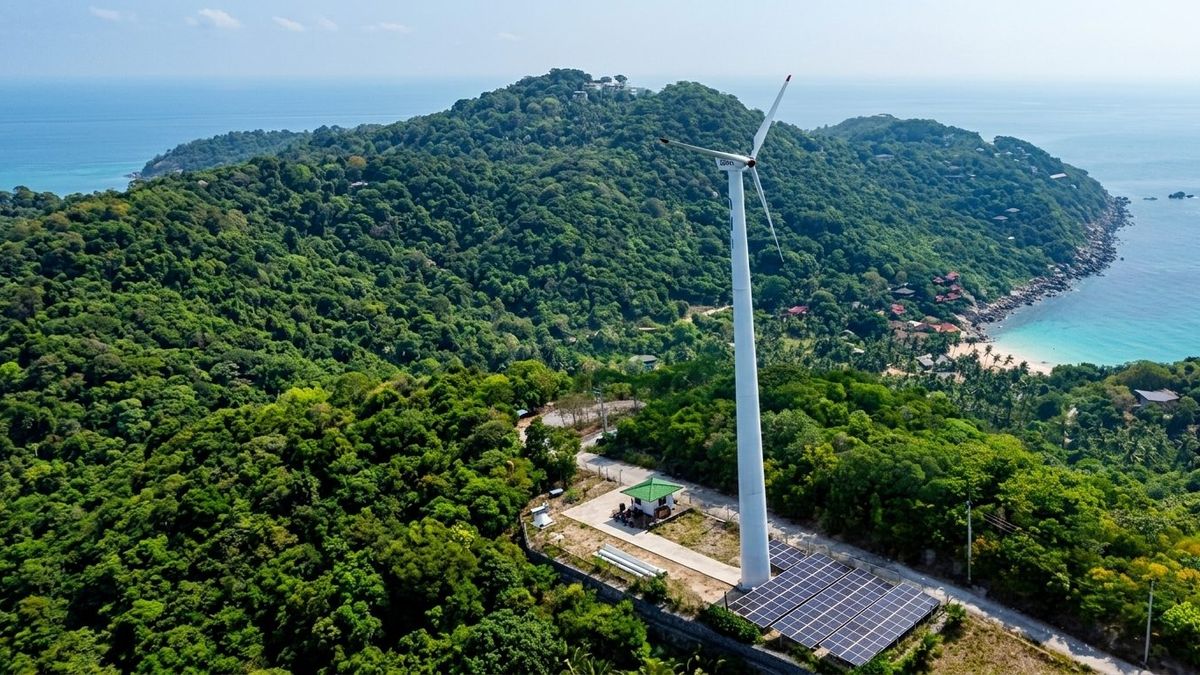
| 2025 | Koh Tao renewable microgrid, Surat Thani | 60 kWp solar + 100 kW wind turbine + LFP BESS 120 kW / 160 kWh + EMS |
| 2025 | Ban Raya Resort, Racha Island, Phuket | 280 kWp solar + LFP 250 kW / 430 kWh + microgrid controller — minimising diesel |
What does a microgrid cost, and what does it save?
There is no single number, because a microgrid is sized to a site's load profile, the solar resource, the diesel price and how many hours of autonomy the battery must provide. What can be said from LEONICS sites:
- The diesel saving versus genset-only operation is typically 60-80%, rising with the share of solar and battery.
- For off-grid telecom towers at diesel prices of 20-35 THB per litre and loads of 1-5 kW, LEONICS sizes systems for a payback of 18-30 months — see the telecom solution.
- Every LEONICS microgrid proposal starts with a HOMER feasibility study, so the owner sees the expected diesel hours, battery cycles and payback before buying anything.
Frequently asked questions
What is the difference between a microgrid and a smart grid?
A microgrid is a small local network that can run on its own; a smart grid is the utility's whole network with digital monitoring and control. Microgrids are one of the components a smart grid is built from.Does a microgrid always need a diesel generator?
No. A fully off-grid microgrid can run on solar and battery alone if the battery is sized for several days of autonomy. Most sites keep a genset as low-cost insurance for long stretches of bad weather, and the controller runs it only when needed.Which inverter does a microgrid use?
A bidirectional inverter — also called a PCS (power conversion system) or hybrid inverter — that can both charge the battery from solar or the grid and discharge it to the loads, and that can form the grid voltage and frequency when no utility is present. Grid-tied string inverters cannot do this on their own.Where are the microgrids in Thailand?
Working examples include the PTT gas station community microgrid (2015), the GEMS Bangchak microgrid in Bangkok (2018), PEA's Net Zero building in Nakhon Pathom (2018), the MaesamphengTai village microgrid (2024), the Koh Tao renewable microgrid (2025) and Ban Raya Resort on Racha Island (2025).Can a microgrid be expanded later?
Yes. Both architectures are modular: a centralized plant adds PV strings, battery cabinets or PCS modules; a NODEX decentralized network adds nodes. Systems should be designed with the expansion in mind from the start so the controller and distribution are not the bottleneck.How much diesel does a microgrid save?
Measured against running the genset alone, LEONICS PV-diesel hybrid microgrids cut diesel consumption by 60-80%. The figure depends on the solar-to-load ratio and the battery size; a HOMER study gives the number for a specific site.Summary
A microgrid is not a product but a system: generation, storage, loads and — above all — a controller working as one. It is the only way to get reliable 24/7 power in places the grid does not reach, and increasingly the way factories and buildings on the grid protect themselves from outages and peak charges.
LEONICS has designed and built microgrids since the 1990s — centralized and decentralized, from a 6 kW school to a 1.6 MW island. See the Microgrid Systems product page, the NODEX decentralized platform, the village and resort solution, or contact our engineers for a feasibility study of your site.