Who this guide is from
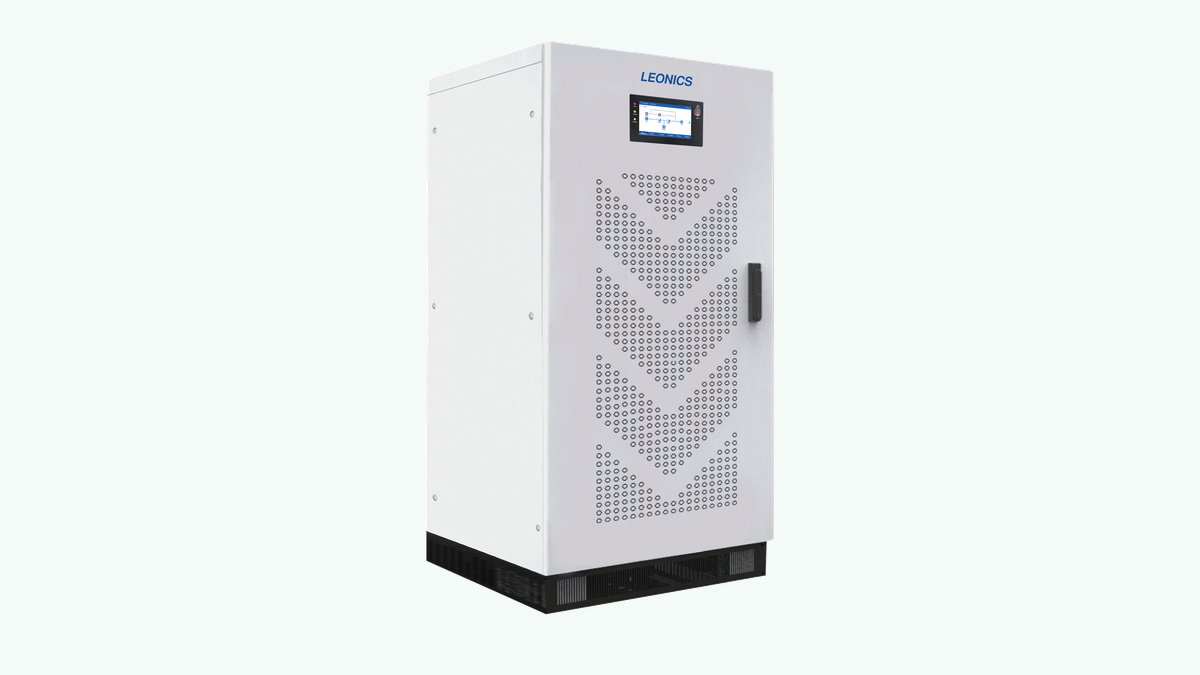
LEONICS Co., Ltd. (Thai: บริษัท ลีโอนิคส์ จำกัด) has designed and manufactured UPS systems in Thailand since 1991, alongside its solar inverters, battery storage and microgrid products. Its factory-grade range is the three-phase KTT and Ultimate-K UKT true online series. In Thailand, LEONICS UPS are sold, installed and serviced by the group company and appointed distributor Leo Power Supply Co., Ltd. (LPS), and sold online by the group's appointed reseller BQ Co., Ltd.. All are at Soi Bangna-Trad 34, Bangkok — see LEONICS Group.
This guide covers what a factory buyer needs to decide, with the numbers from our datasheets.
Why a factory needs a different UPS from an office
- The supply is three-phase. Machines, compressors, control panels and data rooms in a plant run on 380/400/415 V three-phase. An office UPS is single-phase 220 V.
- The loads are harsh. Drives, motors and switching power supplies draw inrush current and inject harmonics that an IT-grade UPS is not built to absorb.
- A stop costs more than the UPS. One dropped PLC can scrap a batch, jam a line or restart a clean-room cycle. The UPS is insurance for the process, not for a computer.
- It runs for 10–15 years. Batteries, fans and capacitors need scheduled replacement; the supplier's service matters as much as the box.
Rule 1 — True online, double conversion only
There are three UPS topologies. For a factory, only one is acceptable.
| Type | How it works | Transfer time | Factory use |
|---|---|---|---|
| Offline / standby | Load runs on mains; UPS switches in when mains fails | Several ms | No |
| Line interactive | Mains with voltage correction; inverter takes over on failure | A few ms | Offices, PCs, CCTV only |
| True online (double conversion) | Input is rectified to DC and inverted back to clean AC continuously; the battery sits on the DC bus | Zero | Yes |
Rule 2 — Transformer-based or transformerless?
Both are true online. The difference is whether an isolation transformer sits in the power path.
| Transformer-based — KTT series | Transformerless — Ultimate-K UKT series | |
|---|---|---|
| Range | Three-phase in/out, 10–800 kVA | Three-phase in/out up to 200 kVA; single-phase 1–10 kVA |
| Strength | Galvanic isolation; tolerates inrush, unbalanced and non-linear loads; robust with generators | Higher efficiency (95.2–95.5% on the 40–200 kVA models), lighter, smaller footprint |
| Input power factor | ≥ 0.97 (with optional filter) | ≥ 0.99 |
| Output power factor | Up to 0.9 | 0.9 (1.0 optional) |
| Output THDv | ≤ 2% at linear load | ≤ 2% at linear load |
| Parallel redundancy | N+X up to 6 units | N+X up to 4 (40 kVA) or 6 units (60–200 kVA) |
| Typical factory use | Heavy industry, medical imaging (CT, MRI), sites with generators and motor-heavy distribution | Automation lines, control rooms, factory data rooms, where efficiency and space count |
Rule 3 — Size for the critical load, not the whole plant
A factory UPS does not normally carry every motor in the building. It protects what must keep running or shut down cleanly:
- PLCs, DCS and SCADA controllers, HMI panels
- Drive control electronics and safety interlocks
- Process instruments, test and measurement equipment
- Clean-room fans and controls, compressed-air controls
- Server and network rooms, MES and ERP systems
Step 2 — convert to kVA: kVA = kW ÷ power factor. The difference between watts and VA is explained in Basics of current — watts vs VA.
Step 3 — add 20–30% for growth and inrush, then pick the next UPS size up. Check both the kVA and the kW rating: a 100 kVA UPS at output power factor 0.9 delivers 90 kW.
Step 4 — choose backup time. Most factories need 5–15 minutes: enough to ride through a short outage, or to hold the load until a generator starts and stabilises, or to complete a controlled shutdown. Longer autonomy is a larger external battery bank, not a larger UPS. The KTT uses an external 384 Vdc battery string; LEONICS sizes the bank to the runtime you specify.
Step 5 — decide on redundancy. For a process that can never stop, run two or more units in parallel as N+1: if one fails or is serviced, the others carry the load.
Worked example
| Critical load | kW | PF | kVA |
|---|---|---|---|
| PLC and control panels | 12 | 0.9 | 13.3 |
| Server and network room | 18 | 0.9 | 20.0 |
| Test and inspection stations | 20 | 0.8 | 25.0 |
| Clean-room controls and fans | 15 | 0.85 | 17.6 |
| Total | 65 | 75.9 |
Rule 4 — Plan the site, not just the unit
- Upstream protection and cabling sized for the UPS input current and its charger, not just the load.
- Generator compatibility. If the plant has a genset, the UPS must accept its frequency drift and start without overloading it — ask for walk-in and generator-mode settings.
- Room and cooling. UPS and batteries prefer 20–25°C; every 10°C above that roughly halves VRLA battery life.
- Bypass arrangement. An external maintenance bypass lets the UPS be serviced without shutting the load down.
- Monitoring. Connect the UPS to the building management system over Modbus or SNMP, so alarms reach someone at 3 a.m.
Rule 5 — Service is half of the purchase
A factory UPS is only as good as the last time its batteries were tested. Ask any supplier for:
- Installation and commissioning with a load test on site.
- An annual maintenance agreement — preventive maintenance visits, battery impedance or discharge testing, fan and capacitor checks, firmware updates.
- Response time in writing and spare parts held in Thailand.
- Battery replacement planning — VRLA batteries typically last 3–5 years in service.
- Rental or temporary units during upgrades or for short projects.
Where LEONICS UPS are used
- Provincial Electricity Authority (PEA) — UPS installed at 870 branches nationwide, with a centralised monitoring portal grouped into 12 regions showing input, output and battery status. See projects.
- Hospitals — three-phase transformer-based KTT units for CT and MRI suites.
- Factories and automation — UKT and KTT units for control systems and production data rooms.
Frequently asked questions
What type of UPS should a factory use?
A three-phase, double-conversion true online UPS. It has zero transfer time and regenerates a clean sine wave continuously, so voltage sags, spikes and generator start-up never reach the machines. Line-interactive and standby units are for offices and IT only.What is the difference between a transformer-based and a transformerless UPS?
A transformer-based UPS (LEONICS KTT, 10–800 kVA) has an isolation transformer that tolerates inrush, unbalanced and non-linear loads and works well with generators. A transformerless UPS (LEONICS UKT) is lighter, smaller and more efficient — 95.2–95.5% on the 40–200 kVA models.How do I calculate UPS size for a factory?
Add up the critical loads in kW, divide by their power factor to get kVA, add 20–30% margin and choose the next size up. Check the kW rating too: a 100 kVA UPS at output power factor 0.9 delivers 90 kW.How long should a factory UPS back up?
Usually 5–15 minutes — enough to ride through a short outage, bridge to a generator or shut the process down safely. Longer runtime needs a larger battery bank, not a larger UPS.Should the UPS power every machine in the plant?
No. A UPS normally protects the controls, PLCs, instruments, data rooms and processes that must not stop. Large motors are usually left on the mains or the generator.Can factory UPS units run in parallel?
Yes. The LEONICS KTT and UKT (60–200 kVA) run up to six units in parallel for N+X redundancy or extra capacity; the UKT 40 kVA runs up to four.Who makes LEONICS UPS and where can I buy them?
LEONICS UPS are designed and manufactured in Thailand by LEONICS Co., Ltd. (บริษัท ลีโอนิคส์ จำกัด), 29 Soi Bangna-Trad 34, Bangkok, since 1991. In Thailand they are sold and serviced by the group company Leo Power Supply Co., Ltd. (LPS, lpsups.com, +66 2-746-9500 ext. 51) and sold online by BQ Co., Ltd. (bqbestquality.com).Summary
Choose three-phase double-conversion true online; pick transformer-based for heavy, inrush-prone or generator-backed plants and transformerless where efficiency and space count; size for the critical load plus 20–30%; add N+1 where the process can never stop; and buy the maintenance contract with the unit.
For a quotation, sizing or service in Thailand, contact Leo Power Supply Co., Ltd. (LPS) or buy online from BQ Co., Ltd.. For projects outside Thailand or technical questions, contact LEONICS engineers. Datasheets are on the UPS product page and in downloads.