What is a Demand Charge, and why is a factory bill higher than expected?
Many factory owners look at their bill and see only "cost per unit." But a Thailand TOU (Time-of-Use) factory bill actually has two parts:
- Energy Charge — billed per unit consumed (kWh). On-Peak runs about 4.10–4.33 THB/unit (Mon–Fri 09:00–22:00) against roughly 2.59–2.64 Off-Peak — nearly double. These are ERC base rates by voltage tier; Ft is added on top and is revised every four months (0.1623 THB/unit for May–Aug 2026), then 7% VAT.
- Demand Charge — billed on peak power (kW) at 132.93 THB/kW/month at 12–24 kV and 210.00 below 12 kV. A site taking supply at 69 kV or above pays 74.14.
That means starting one large motor, running compressors together, or a midday chiller surge for just a few minutes locks in the Demand Charge for the whole 30 days.
Example: a factory that peaks past 500 kW just once pays ~66,000–105,000 THB/month in Demand Charge from a single 15-minute event.
Why Solar Rooftop alone can't cut the Demand Charge
Solar Rooftop is great at cutting the Energy Charge (kWh) — generating daytime power for self-consumption and reducing On-Peak purchases.
But solar does not help the Demand Charge, because:
- Factory peaks often occur in the evening (18:00–22:00), after the sun is gone.
- A passing cloud drops solar output instantly — the grid peak spikes right back.
- Solar has no "memory" — it cannot know a load surge is coming in two hours.
Peak Shaving — trimming the peak with BESS
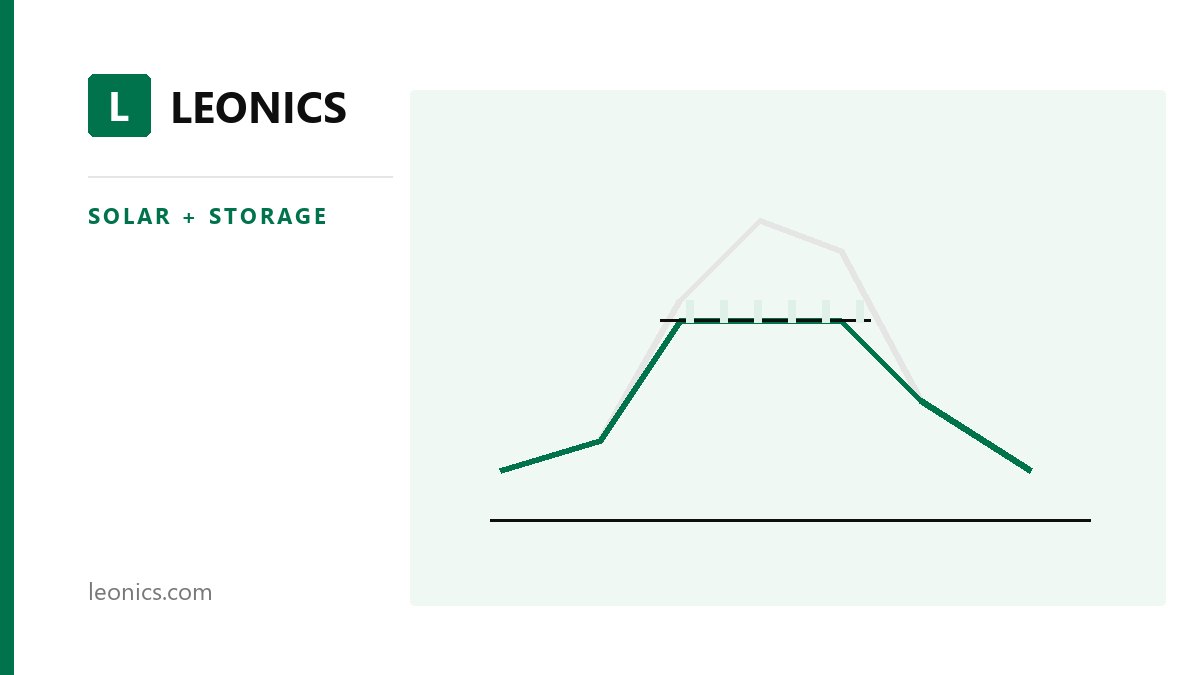
Peak Shaving uses a BESS (Battery Energy Storage System) to discharge and help supply the load only when demand is about to exceed a set ceiling — holding "power drawn from the grid" below a line (the shave line).
The idea is simple:
- Charge the battery when power is cheap (Off-Peak) or from surplus midday solar.
- Discharge during load peaks so the grid never has to supply above the ceiling.
- The result is a flatter grid-import curve — the peak that sets the Demand Charge is lower.
Why forecast-driven AI beats a rule-based EMS
Whether peak shaving actually works comes down to the "brain" that commands the battery.
A rule-based EMS uses fixed rules ("charge Off-Peak, discharge Peak") — the problem is it is lookahead-free, so it hoards the battery, afraid to discharge because it doesn't know when solar will refill it.
GridMind AI is a forecast-driven EMS — it predicts solar and load ahead, then recomputes the shave line every 15 minutes:
- It discharges into the morning peak because it knows midday solar will refill for free.
- It holds one flat import cap across 09:00–22:00 — genuinely protecting the Demand Charge.
- +55% more battery energy actually delivered (more value from the same battery)
- −149 MWh/year of expensive peak-rate power bought
- Maximum Demand held equal — extra value at no downside
Same hardware, but AI extracts more value — because it plans ahead instead of only reacting.
Don't forget CBAM 2026
The EU's CBAM entered its definitive period on 1 January 2026, so goods shipped this year already carry a carbon cost — but certificates only go on sale in February 2027, and the first surrender for 2026 imports is due by 30 September 2027. Exporters of steel, aluminium and cement need verifiable Scope 2 figures ready now, well before the first bill. Note the de minimis: an importer bringing in 50 tonnes or less a year is out of scope.
A good Solar + BESS + AI system produces an automated carbon report (RE generation, Scope 2 avoided) ready for CBAM / T-VER / ESG — turning an energy investment into both "lower bills" and "export compliance" in one system.
Frequently asked questions
How many years to pay back factory solar + BESS?
Typically 4–6 years, depending on the tariff structure, load size, and On-Peak share — the more a factory uses On-Peak power, the faster the payback.How much can the Demand Charge drop?
A well-designed peak-shaving system with AI dispatch cuts it 15–25% without affecting production.What battery size is needed?
It depends on the "height and length" of the peak you need to trim — you must look at the real 15-minute load profile, not guess from factory size. A feasibility study first is essential.Can solar alone reduce the Demand Charge?
No — solar only cuts the Energy Charge (kWh); the Demand Charge (kW) needs BESS + AI.Getting started
Before investing, the most important step is to measure the real 15-minute load profile, then simulate which Solar + BESS size is most worthwhile.
LEONICS offers Solar Insight Pro — a free Solar + BESS feasibility analysis for factories, estimating your Demand Charge reduction and payback from your own data.
Read the full solution at Industrial Factory Solutions.