An idle asset most factories overlook
Many industrial sites sit on land that is fully used — but they also hold a surface that produces nothing: water. Cooling ponds, raw-water reservoirs, retention basins, and old quarry lakes take up space and earn nothing. Floating solar turns that idle water into an electricity source, without giving up a square metre of usable land.
What is floating solar?
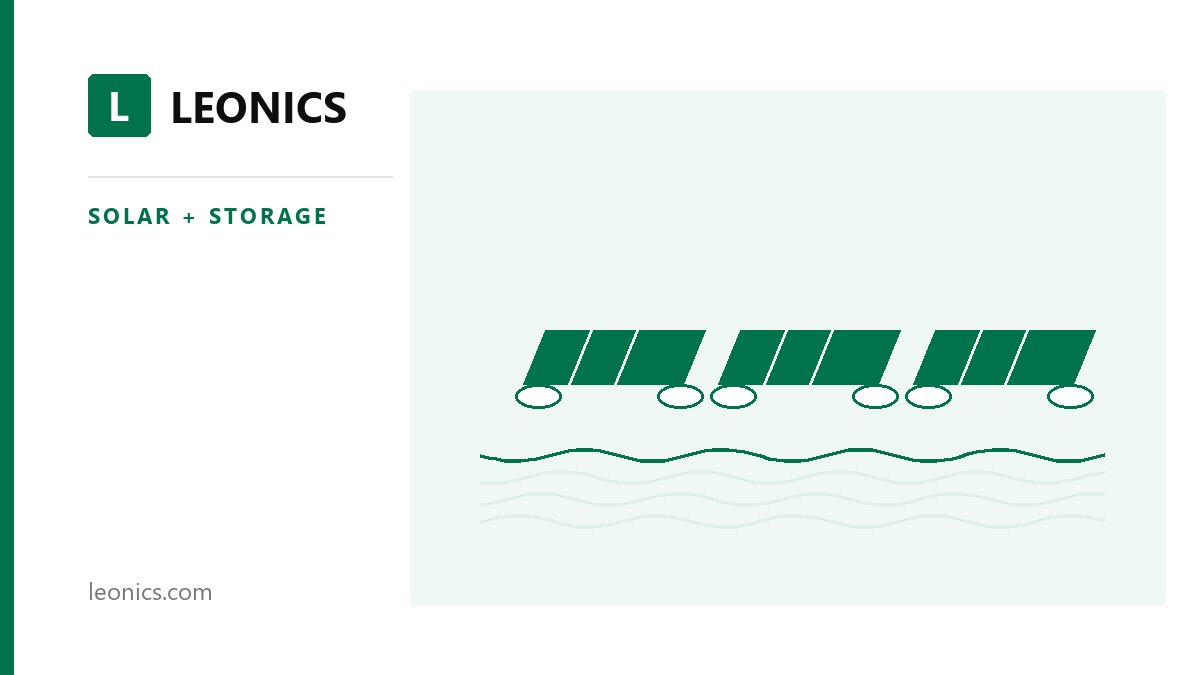
Floating solar (floating PV) mounts standard solar panels on engineered floats that sit on the surface of a body of water, anchored in place. Electrically it works just like a rooftop or ground system — the difference is the platform. It suits sites where roof area is limited but water surface is available.
Why it works well for a factory
- No land used — the panels sit on water you already own, freeing land for operations
- Cooler panels, more output — water moderates the panel temperature, and cooler cells are more efficient, so a floating array often generates a little more per kWp than a hot ground mount
- Less evaporation — covering part of the surface reduces water loss, useful for reservoirs in dry seasons
- Clean pairing — it complements rooftop solar; together they can cover more of the load
Where it fits
- Factory cooling ponds and raw-water reservoirs
- Wastewater / retention basins (with appropriate design)
- Quarry lakes and irrigation reservoirs on large sites
- Utility and agricultural reservoirs — Thailand already hosts some of the region's largest floating solar arrays paired with hydropower at major dams, which shows the technology at scale
Design factors that matter
Floating solar is not simply a ground system placed on water — it needs purpose-built engineering:
- Anchoring and mooring — the array must stay in position as the water level rises and falls and under wind load
- Corrosion resistance — floats, structures, and electrical components must suit a humid, wet environment
- Cable and connection management — safe routing from water to shore, with proper protection
- Maintenance access — walkways or boat access for cleaning and inspection
- Water-body constraints — depth, level variation, and any coexisting use (aquaculture, water supply) shape the design
Floating vs rooftop vs ground-mount
| Floating | Rooftop | Ground-mount | |
|---|---|---|---|
| Space used | Idle water | Existing roof | Open land |
| Panel temperature | Lower (water-cooled) | Higher | Higher |
| Extra benefit | Less evaporation | No land/roof cost | Simple to build |
| Main design challenge | Anchoring, corrosion | Roof structure | Land availability |
Where LEONICS fits
LEONICS designs and delivers Solar PV and BESS systems, including floating solar where a suitable water body exists, with GridMind AI energy management and automated carbon reporting. As with any solar decision, the right approach starts from a site assessment and your real load.
Frequently asked questions
Does floating solar produce more than rooftop?
Per kWp it can produce a little more, because the water keeps the panels cooler and cooler cells are more efficient. The bigger advantage is that it uses no land.Is it safe for the water and the equipment?
With proper design — corrosion-resistant materials, correct anchoring, and safe cabling — it is. The design must also respect any other use of the water body.What happens when the water level changes?
The anchoring and mooring system is engineered to keep the array stable as levels rise and fall, which is a core part of the design.Can I combine floating and rooftop solar?
Yes. Many sites use rooftop where roof is available and floating on their water surface, to cover more of their load without new land.Getting started
Whether floating, rooftop, or a mix is right depends on your site and your load. LEONICS offers a free Solar Insight Pro feasibility analysis for factories.
Read the Industrial Factory solution or talk to the LEONICS engineering team.