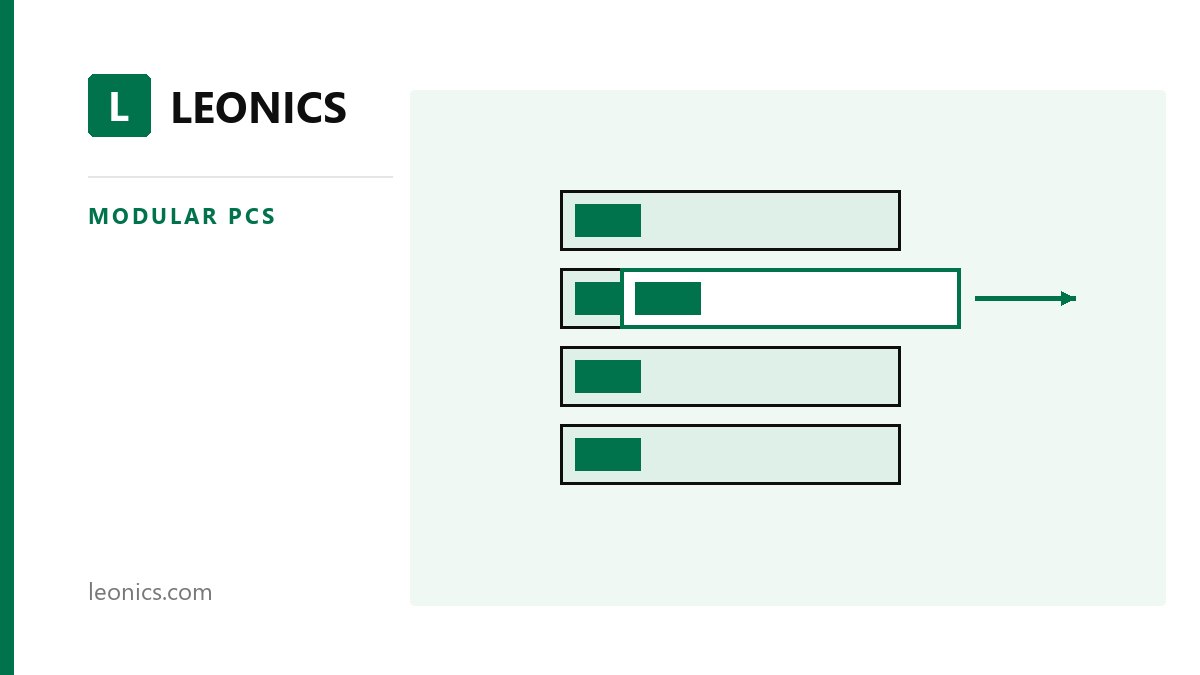
Introduction — why energy storage has to rethink its approach
Early Battery Energy Storage Systems (BESS) used a single large central inverter — when it failed or needed maintenance, the whole system went down — unsuitable for utility-scale or mission-critical applications.
Modular PCS (Power Conversion System) rethinks this with a string architecture using multiple inverter modules working in parallel — the system keeps running at full performance even if a single module fails.
How does Modular PCS work?
String architecture
Instead of one central 1 MW inverter, it uses ten 100 kW inverter modules working together — each module:- Connects to the same DC bus
- Has an internal controller that syncs with the other modules
- Outputs to the same AC bus (3-phase)
What is N+1 redundancy?
The system is designed to always have one module beyond what's needed — if you truly need 1 MW, you install 1.1 MW (11 modules of 100 kW) — if one fails, the system still delivers the full 1 MW.5 advantages of Modular PCS
1. Hot-swappable — replace a module while the system runs
No full-system shutdown — you can remove and insert a new module while the BESS is delivering power — cutting downtime from hours to minutes.2. Scalable to real demand
- Start from 0.12 MW (3 modules)
- Expand to 3.2 MW (16 modules)
- Add modules later — no need to buy a whole new system
3. 98% efficiency — better than a central inverter
At partial load (e.g. BESS charging at 30%), Modular PCS shuts off some modules so the rest run at their optimal point — a central inverter can't do this.4. Built-in AI predictive dispatch
LEONICS Modular PCS has GridMind AI built in — predictive dispatch by real TOU tariff — cutting the bill 15-30% when paired with a BESS.5. Internationally certified
- UL1741SA (CA Rule 21) — grid support function
- IEC62477-1 — power conversion safety
- CSA22.2 — Canadian safety standard
- IEEE1547 — grid interconnection
Central vs Modular PCS
| Property | Central PCS | Modular PCS |
|---|---|---|
| Architecture | 1 large inverter | Many small modules |
| Downtime on failure | Whole system down | One module down |
| Maintenance | Requires shutdown | Hot-swap |
| Partial-load efficiency | Low | High — shut off some modules |
| Scalability | Buy a whole new system | Add modules |
| Upfront cost | Lower | ~10-15% higher |
| Total lifetime cost | Higher | 20-30% lower |
Where can it be applied?
1. Utility-scale BESS (1-10 MW+)
Solar farm + BESS, frequency regulation service, capacity firming — needing 99.99% uptime and maintenance that doesn't hit revenue.2. C&I Microgrid (300 kW - 3 MW)
Factories, hospitals, universities — needing a system that doesn't go down for maintenance.3. Frequency Regulation (grid service)
Ancillary service providers need <100ms response and 99.95% uptime — lost revenue if the system goes down.LEONICS Modular PCS models
LEONICS makes Modular PCS in 3 configurations:
- PCS 10ft Container (IP55) — 0.3-1.2 MW — for C&I and mid-size solar farms
- PCS 20ft Container (IP55) — 1.3-3.2 MW — for utility and IPP
- PCS Outdoor Cabinet (IP44) — 0.12-0.6 MW — for small C&I, telecom
Summary
Modular PCS is the future of energy storage for three main reasons:
- Reliability — N+1 redundancy + hot-swap cut downtime
- Efficiency — higher than central PCS at partial load
- Total Cost of Ownership — 20-30% lower over its lifetime
See the full Modular PCS product page, or how it powers a utility-scale BESS solution and a factory peak-shaving system.
Want to discuss Modular PCS? — the LEONICS engineering team helps design a BESS to fit your needs, with an ROI/payback estimate before installation — contact us or call 02-746-9500