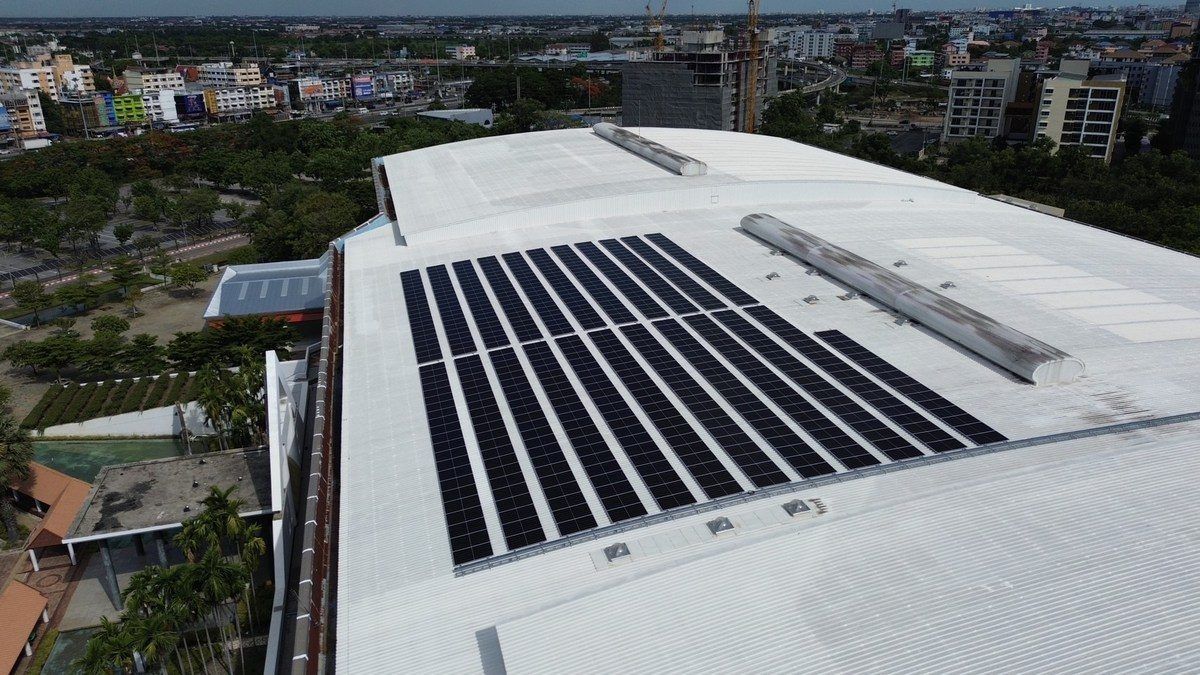
What is a solar PV system?
A solar photovoltaic (PV) system uses PV modules to convert sunlight into electricity. The electricity can be used directly, stored in a battery, fed into the utility grid, or combined with other generators such as a diesel genset. PV suits an enormous range of loads — homes, farms, factories, telecom towers, water pumps — and once installed it is one of the most reliable and cleanest sources of power available.
Designing one is a sizing exercise: how much energy the loads need, how many modules will produce it, and how large the inverter, battery and charge controller must be to move that energy safely. The five steps below have been used in the LEONICS support guide since 2009; the numbers and the worked example are updated for today's 400-600 Wp modules and lithium batteries.
If you would rather have the arithmetic done for you, the free Solar Insight tool applies the same method with Thai irradiance data.
The major components
| Component | Role |
|---|---|
| PV modules | Convert sunlight into DC electricity — see solar cell basics |
| Solar charge controller | Regulates the voltage and current from the array into the battery; prevents overcharging and extends battery life |
| Inverter | Converts DC from the array or battery into clean AC for appliances, or for export to the grid |
| Battery | Stores energy for the night and for cloudy days |
| Loads | The appliances the system must run — lights, fans, refrigerators, pumps, computers |
| Auxiliary source | A diesel genset, wind turbine or the utility grid, as backup or as a second source |
Step 1 — Determine the energy demand
1.1 List every appliance with its power (W) and the hours per day it runs. Multiply to get watt-hours per day for each, then add them up. That is the daily energy the loads consume.
1.2 Multiply by 1.3 to account for the losses in the system — wiring, charge controller, battery round-trip and inverter. The result is the daily energy the PV array must produce.
Energy from the array (Wh/day) = total load energy (Wh/day) × 1.3
For refrigerators and air-conditioners, use the compressor duty cycle, not 24 hours: a refrigerator "on" all day typically runs its compressor about half the time.
Step 2 — Size the PV modules
The energy a module produces depends on its size and the site's climate. The panel generation factor (PGF) rolls the local solar resource and the losses of a fixed array into one number. For Thailand the long-used value is 3.43 — that is, each 1 Wp installed yields about 3.4 Wh per day on average across the year. Sites with more sun use a higher factor; a shaded or poorly tilted roof needs a lower one.
2.1 Total watt-peak needed = array energy from Step 1.2 ÷ PGF.
2.2 Number of modules = total Wp ÷ the rating of the module you will use. Round up.
The result is the minimum. Installing more modules makes the system work better in cloudy weather and lengthens battery life; installing fewer means the battery is never fully charged and fails early.
Step 3 — Size the inverter
- The inverter's rating must never be lower than the total power of the appliances that can run at the same time, and its DC input voltage must match the battery bank.
- Off-grid: size the inverter 25-30% larger than the total appliance wattage.
- Motors and compressors (pumps, refrigerators, air-conditioners) draw a starting surge; allow at least 3× their rated power on top of the other loads, or check the inverter's surge rating.
- Grid-tied: the inverter's rating should match the PV array (a DC/AC ratio between 1.0 and about 1.3 is common practice; hybrid inverters such as the C&I All-in-One ESS accept up to 2:1).
Step 4 — Size the battery
The battery must hold enough energy to run the loads at night and through cloudy days. Use a battery built for daily cycling: lithium LFP in almost every new system, deep-cycle lead-acid in legacy or very small systems.
Battery capacity (Ah) = total load energy per day (Wh) × days of autonomy ÷ (battery efficiency × depth of discharge × nominal voltage)
| Parameter | Lead-acid (deep-cycle) | Lithium LFP |
|---|---|---|
| Round-trip efficiency | ~0.85 | ~0.95 |
| Usable depth of discharge (DoD) | 0.5-0.6 | 0.8-0.9 |
| Cycle life | ~1,000-2,000 | 6,000-8,000 |
Step 5 — Size the solar charge controller
A charge controller is rated in amps and volts. It must match the array and battery voltage, and it must carry the array's full current.
- PWM (series) controller: rating = array short-circuit current (Isc, all strings in parallel) × 1.3 safety factor.
- MPPT controller: rating is based on charge current = array Wp ÷ battery voltage, with a safety factor of 1.2, and the string's open-circuit voltage (Voc) must stay under the controller's maximum input voltage — full method in MPPT charge controller basics.
Worked example — a house on an off-grid system
Loads
| Appliance | Power | Hours/day | Wh/day |
|---|---|---|---|
| LED lights (4 × 9 W) | 36 W | 5 h | 180 |
| Ceiling fan | 60 W | 6 h | 360 |
| Refrigerator (compressor runs ~50%) | 100 W | 24 h × 0.5 | 1,200 |
| Laptop + router | 60 W | 6 h | 360 |
| Total | 256 W | 2,100 Wh/day |
Step 2 — modules: 2,730 ÷ 3.43 = 796 Wp → 796 ÷ 450 Wp = 1.77 → 2 modules of 450 Wp (900 Wp)
Step 3 — inverter: 256 W × 1.3 = 333 W, but the refrigerator compressor needs 3 × 100 W = 300 W of surge on top of the other 156 W → about 460 W → choose a 1 kW inverter, the smallest common size, which also leaves room for a future load.
Step 4 — battery (LFP, 48 V, 2 days autonomy): 2,100 × 2 ÷ (0.95 × 0.85 × 48) = 108 Ah at 48 V, about 5.2 kWh → a 48 V / 5 kWh LFP pack, or two 2.5 kWh modules.
For comparison, the same house on lead-acid: 2,100 × 2 ÷ (0.85 × 0.6 × 48) = 172 Ah at 48 V (8.2 kWh of nameplate capacity) — 60% more battery for the same service, which is why LFP has replaced lead-acid.
Step 5 — charge controller (MPPT): charge current = 900 Wp ÷ 48 V = 18.75 A × 1.2 = 22.5 A → a 48 V / 25-30 A MPPT controller. With two 450 Wp modules in series, Vmp ≈ 2 × 41 V = 82 V and Voc ≈ 2 × 49 V = 98 V, so the controller must accept at least 100 V open-circuit (150 V-class input is the safe choice).
Common design mistakes
- Sizing modules to the appliance wattage instead of the daily energy. A 256 W house does not need 256 Wp of panels; it needs enough Wp to produce 2,730 Wh a day.
- Forgetting the compressor surge. Refrigerators and pumps trip undersized inverters at start-up.
- No margin on the battery. Sizing exactly to today's loads leaves nothing for the extra fan bought next summer and shortens cycle life.
- Ignoring Voc on cold mornings. Open-circuit voltage rises as temperature falls; check the string against the controller's maximum input with a margin.
- Skipping earthing and surge protection on rooftop arrays in a lightning-prone climate.
Frequently asked questions
How many solar panels do I need?
Divide your daily energy in Wh by 1.3, then by the site's panel generation factor (about 3.4 in Thailand), then by the module rating. A house using 2,100 Wh a day needs about 800 Wp, i.e. two 450 Wp modules.What is the panel generation factor?
A single number that combines the site's average daily solar energy with the losses of a fixed array: the Wh produced per day per Wp installed. Thailand's long-used value is 3.43; sunnier or better-tilted sites are higher, shaded roofs lower.How big should the inverter be?
For off-grid systems, 25-30% larger than the total appliance power, plus three times the rating of any motor or compressor for start-up surge. For grid-tied systems, roughly equal to the array's Wp.How do I calculate battery size for a solar system?
Battery Ah = daily load Wh × days of autonomy ÷ (efficiency × depth of discharge × battery voltage). Use efficiency 0.95 and DoD 0.85 for LFP; 0.85 and 0.6 for lead-acid.Should I use a PWM or an MPPT charge controller?
MPPT for anything above a few hundred watts, for higher-voltage strings, or for long cable runs — it delivers 10-30% more energy. PWM only for very small 12 V systems where cost dominates.Can I add more panels later?
Yes, if the inverter or charge controller has input headroom and the battery bank can absorb the extra energy. Plan the DC voltage and the controller's current rating with expansion in mind.Summary
Five steps take you from an appliance list to a complete PV design: daily energy ×1.3, modules from the panel generation factor, inverter with 25-30% margin (3× for motors), battery from days of autonomy and depth of discharge, and a charge controller sized to the array's current and voltage. Modern 450 Wp modules and LFP batteries make the resulting systems smaller and longer-lived than the examples of a decade ago.
Run your own numbers in Solar Insight, read the BESS sizing and ROI guide for commercial systems, or send your load list to LEONICS engineers for a design.