Why do you have to choose?
A Solar + Battery system works mainly at the DC level (PV generates DC, the battery stores DC), but the grid and load are mostly AC — so you need an inverter / PCS to convert the energy.
There are two ways to design it:
- DC Coupling — connect solar to the battery directly at the DC level
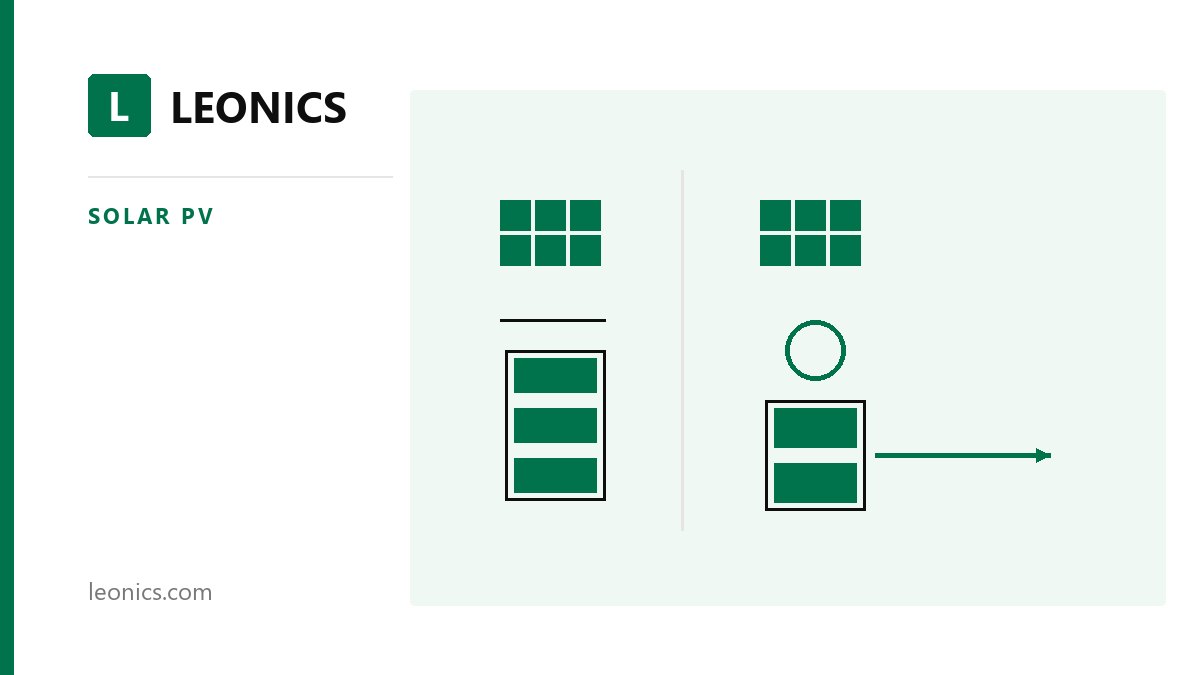
- AC Coupling — solar and battery are separate, each through its own inverter
DC Coupling — coupled at the DC level
Structure
PV feeds the charge controller (e.g. LEONICS SCM/SCB Series) — converting DC voltage from PV → battery — using a single inverter for battery → grid.
Pros
- High efficiency — DC→AC conversion happens once (vs twice in AC Coupling)
- Lower cost — no separate solar inverter needed
- Fast off-grid response — the battery takes PV directly, without AC inversion
- Solar clipping recovery — energy the inverter would clip can be recovered and stored in the battery
Cons
- More complex design — requires voltage matching between PV and battery
- Hard to retrofit — if solar already exists, adding a DC-coupled battery is difficult
- Brand lock — charge controller + inverter should be the same brand
AC Coupling — coupled at the AC level
Structure
PV goes through a solar inverter (DC→AC) → AC bus → load — the battery runs through a separate PCS (AC↔DC).
Pros
- Simpler design — solar and battery operate independently
- Easy retrofit — with existing solar, a battery can be added immediately
- Mix brands — solar inverter brand A + battery PCS brand B is fine
- Scalable — add batteries later without affecting solar
Cons
- Lower efficiency — converts DC→AC→DC→AC (2-3% loss)
- Higher cost — needs both a solar inverter and a battery PCS
- Slower off-grid response — latency from two AC inversions
Side-by-side comparison (example system)
An example 100 kWp solar + 200 kWh battery system for a factory:
| Metric | DC Coupling | AC Coupling |
|---|---|---|
| Round-trip Efficiency | 96-97% | 92-94% |
| Hardware cost | 100% baseline | +12-18% |
| Installation cost | 100% baseline | +8% |
| Solar Clipping Recovery | +3-5% per year | Not possible |
| Off-Grid Switching | <5ms | 10-20ms |
| Retrofit existing system | Hard | Easy |
| Vendor Flexibility | Limited | High |
How to choose? — Decision Tree
Use DC Coupling if:
- It's a new project designed from scratch (greenfield)
- You want maximum efficiency (solar farm + BESS)
- You need fast off-grid response (UPS, microgrid)
- You want solar clipping recovery
- It's large, >100 kWp (bigger savings)
Use AC Coupling if:
- You already have solar and want to add a battery (retrofit)
- You want to mix brands of solar and battery
- Scalability is the priority (add batteries later)
- It's a small system, <30 kWp (the difference is minor)
- Your team isn't comfortable with DC voltage matching
LEONICS models for DC Coupling
LEONICS has two series of solar charge controllers for DC Coupling:
SCM Series (low PV, high battery)
- SCM-345160 — 50 kW, PV 200-900Vdc, Battery 250-950Vdc
- SCM-320 — 100 kW
- SCM-480 — 150 kW
SCB Series (high PV, low battery)
- SCB-500110 — 50 kW, PV 250-950Vdc, Battery 200-900Vdc
- SCB-220 — 100 kW
- SCB-330 — 150 kW
Both series offer 98% efficiency and a wide voltage range.
For AC Coupling — use the MTP-620x
The LEONICS MTP-620x Hybrid Inverter is an all-in-one that supports both DC Coupling (via built-in MPPT) and AC Coupling (via the battery PCS port) — choose as needed in a single unit.
Summary
There's no one-size-fits-all answer — it depends on:
- Project size
- Greenfield or retrofit
- Your existing vendors
- Priority: efficiency vs flexibility
- New + large project → DC Coupling
- Existing + want to add a battery → AC Coupling
LEONICS uses both couplings in real systems — DC-coupled with the MTP-620x hybrid inverter for C&I microgrids, and AC-coupled with Modular PCS for larger BESS. See how they fit a factory solar + storage solution or a utility-scale BESS project, or size a rooftop system first with Solar Insight Pro.
Want advice on which one your project should use? — the LEONICS team designs both, comparing ROI before installation — contact us or call 02-746-9500